

Blood Sugar, Cholesterol, and Inflammation
When most people think about cacao and health, they think about the heart. That connection is well-documented and we cover it in depth elsewhere on this site. But the research points to something broader.
The same compounds in cacao that benefit your cardiovascular system also appear to influence several other markers that doctors watch closely: blood sugar, cholesterol levels, and inflammation. Together, these are sometimes called cardiometabolic health - the intersection of heart and metabolic function.
Here's what the science shows.
The Study That Pulled It All Together
In 2016, researchers published a comprehensive meta-analysis in the Journal of Nutrition - one of the most rigorous forms of scientific review - in which researchers combine and re-analyze data from multiple independent studies to identify patterns that hold up across different populations and research teams.
This analysis pooled data from 19 randomized controlled trials involving 1,131 participants, all of which examined the effects of cocoa flavanol consumption on cardiometabolic biomarkers. The results across several categories were consistent and statistically significant.1
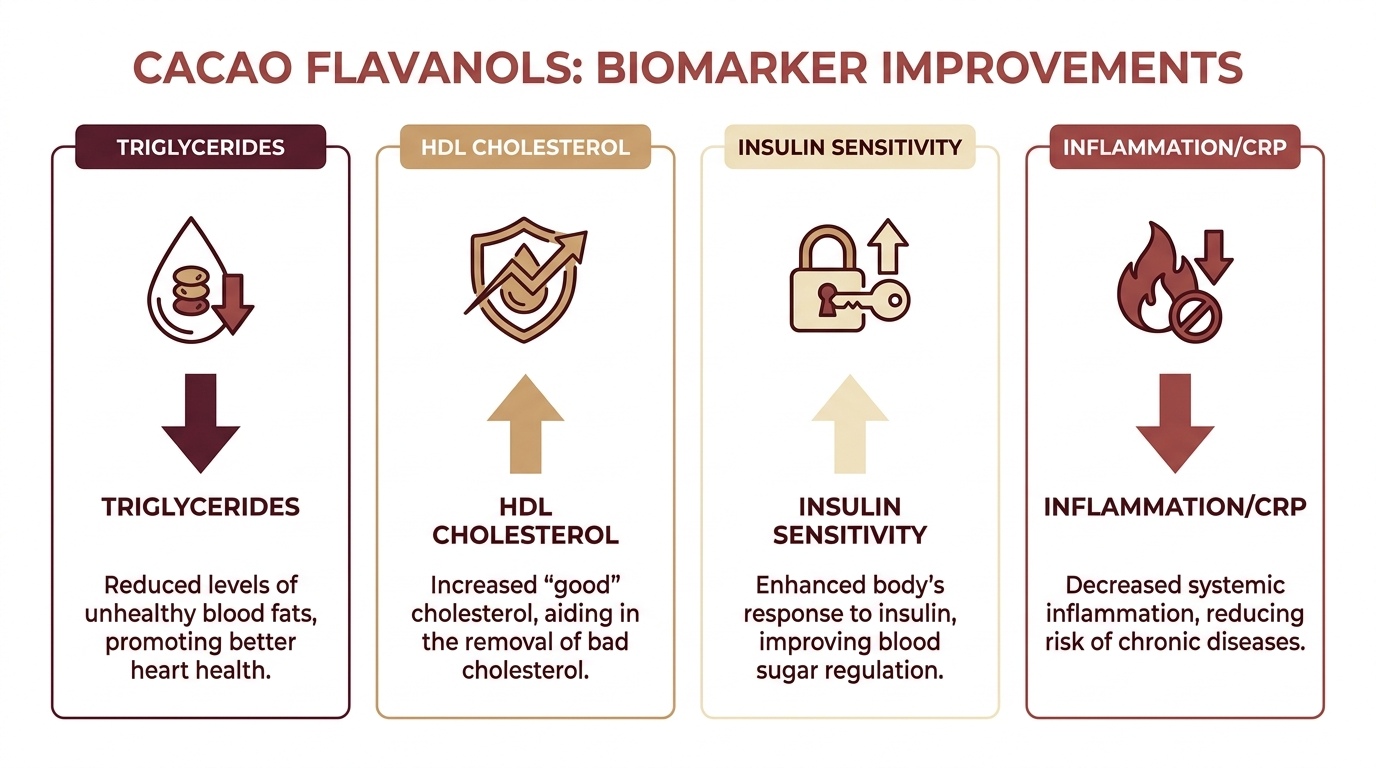
Triglycerides
Triglycerides are a type of fat found in your blood. When you eat more calories than you burn, your body converts the excess into triglycerides and stores them. High triglyceride levels are associated with increased risk of heart disease, and they often accompany other metabolic issues like insulin resistance and low HDL cholesterol.
Across the 19 trials in the meta-analysis, cocoa flavanol consumption produced a statistically significant reduction in triglyceride levels.1 This isn't a dramatic effect, but it's consistent and shows up reliably across different study designs, populations, and durations.
HDL Cholesterol - The "Good" Kind
Cholesterol is often discussed as if it's a single bad thing, but the picture is more nuanced. LDL cholesterol (often called "bad" cholesterol) can build up in artery walls. HDL cholesterol (the "good" kind) does the opposite - it helps transport cholesterol away from arteries and back to the liver for processing.
Low HDL is a recognized cardiovascular risk factor. The meta-analysis found that cocoa flavanol consumption was associated with a meaningful increase in HDL cholesterol.1 The Flaviola Health Study, a separate European trial, confirmed this finding - participants taking high-flavanol cocoa twice daily for one month saw their HDL levels rise alongside improvements in blood pressure and arterial function.2
Blood Sugar and Insulin Sensitivity
Insulin is the hormone that allows your cells to absorb glucose from the bloodstream. When cells become resistant to insulin (a condition called insulin resistance) blood sugar stays elevated, the pancreas works harder, and the risk of type 2 diabetes climbs.
The meta-analysis measured insulin resistance using a standard clinical marker called HOMA-IR (Homeostatic Model Assessment for Insulin Resistance). Participants consuming cocoa flavanols showed significantly improved insulin sensitivity - meaning their cells became more responsive to insulin, and their bodies were better able to regulate blood sugar.1
Inflammation
C-reactive protein (CRP) is a substance produced by the liver in response to inflammation. It's one of the most widely used clinical markers for systemic inflammation and chronically elevated CRP is associated with heart disease, metabolic syndrome, and a range of other conditions.
The meta-analysis found that cocoa flavanol consumption was associated with reduced levels of CRP - suggesting an anti-inflammatory effect on top of the cardiovascular and metabolic benefits.1
Putting It Together
None of these findings exist in isolation. Triglycerides, HDL, insulin sensitivity, and inflammation are all interconnected markers of overall metabolic health, and they're all influenced, in the same direction, by the flavanols found in high-quality cacao.
Quality matters here, as it does throughout cacao research. The flavanol content of commercial chocolate and processed cocoa products varies enormously. The studies generating these results used preparations specifically designed to preserve and deliver meaningful flavanol concentrations - the kind of processing philosophy that underlies how ceremonial cacao is made.
Research Sources
- Lin X, Zhang I, Li A, et al. Cocoa flavanol intake and biomarkers for cardiometabolic health: a systematic review and meta-analysis of randomized controlled trials. Journal of Nutrition. 2016;146(11):2325–2333. https://doi.org/10.3945/jn.116.237644
- Sansone R, Rodriguez-Mateos A, Heuel J, et al. Cocoa flavanol intake improves endothelial function and Framingham Risk Score in healthy men and women: the Flaviola Health Study. British Journal of Nutrition. 2015;114(8):1246–1255. https://doi.org/10.1017/S0007114515002822
- Rees A, Dodd GF, Spencer JPE. The effects of flavanols on cardiovascular health: a review of current evidence and emerging perspectives. Nutrients. 2018;10(11):1852. https://doi.org/10.3390/nu10111852