

Deepening Your Relationship with Cacao
Most people's relationship with cacao begins and ends at the grocery store. A bar of chocolate, a canister of cocoa powder for baking. Something sweet, something familiar, something consumed without much thought.
That's a perfectly fine place to start. But there's a lot more available if you want it.
Start with the Source
The single most meaningful shift you can make is paying attention to where your cacao comes from. This sounds obvious, but it's genuinely clarifying when you actually do it.
Cacao is an agricultural product, and like all agricultural products, its quality varies enormously depending on the variety, the soil, the climate, the fermentation process, and the handling after harvest. A cacao pod grown in the shade forests of South America and fermented by a small cooperative is a fundamentally different ingredient than commodity cacao grown for volume on a West African plantation.
Sourcing matters both ethically and experientially. When you know something about the farm or the region - the altitude, the people who grew it, what the cooperative stands for - you bring that context to the cup. There's a difference between eating something and knowing nothing about it, and eating something with a sense of its story.
Slow Down the Preparation
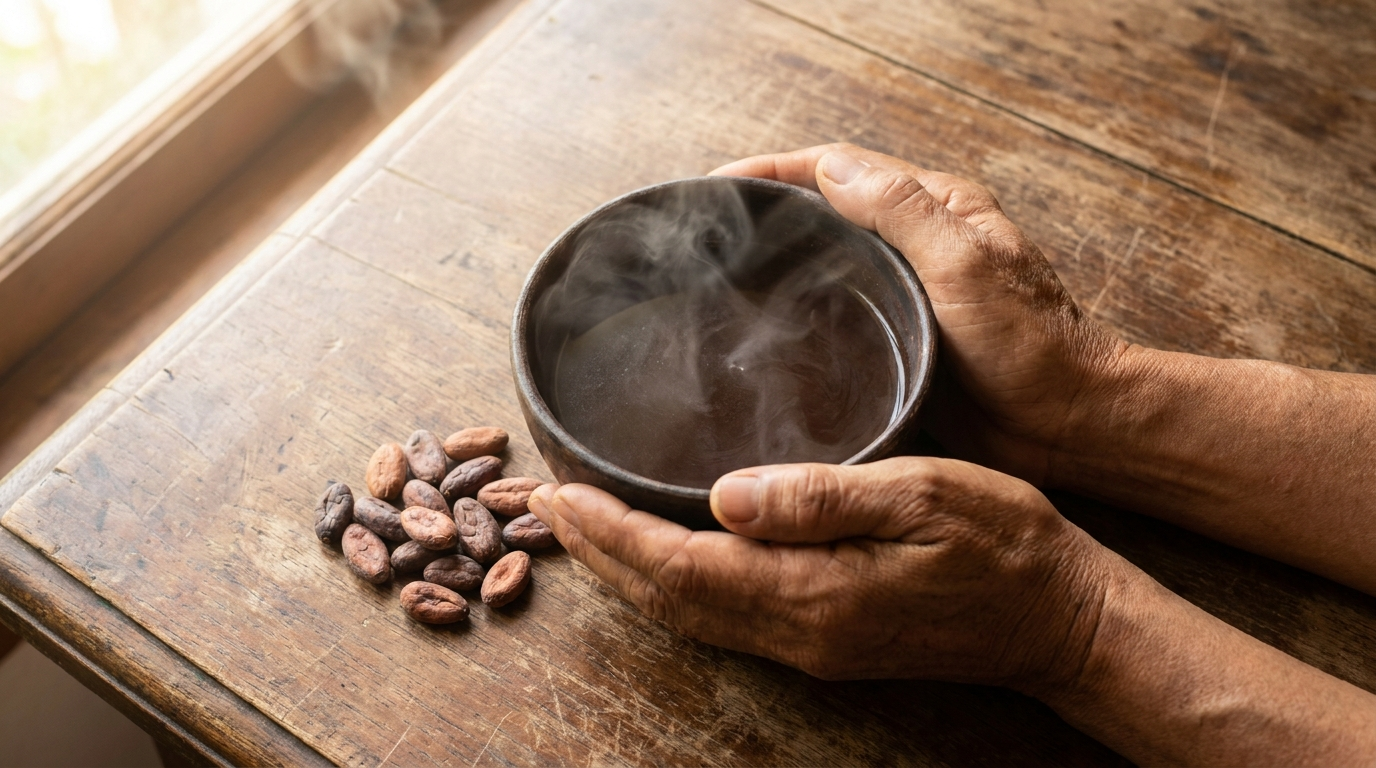
Ceremonial cacao preparation is slow by design. You're working with solid cacao paste, adding hot water gradually, stirring or whisking. The process takes a few minutes. That's a feature, not a bug ;-)
The act of preparing something with your hands, with attention, changes your relationship to it before you even take a sip. You're not tearing open a packet and adding hot water. You're working with a raw material that has texture and weight and smell. The cacao warms in the pot and the kitchen starts to smell earthy and slightly bitter and complex. You're paying attention in a way that a K-cup doesn't require.
This is a practical suggestion, not a mystical one. When you make something slowly, you notice it more. When you notice it more, you enjoy it more. The research on mindful eating consistently shows that attention shapes experience. Preparation is part of that.
Drink It Without Distraction
This is the harder one for most people.
Ten minutes with a cup of cacao and no screen in front of you feels long in a way it didn't used to. That's worth sitting with rather than resolving by reaching for your phone.
Drinking cacao without distraction isn't about achieving any particular mental state. It's just about being present with the experience - the temperature of the cup, the taste on different parts of your tongue, how the feeling in your body shifts as you drink. Cacao is genuinely complex to taste. There's bitterness, earthiness, a slight fruity brightness in good single-origin beans, a warmth that comes partly from the theobromine and partly just from the hot liquid. You won't notice most of it if you're also reading something.
If sitting quietly feels uncomfortable, notice that too. It's useful information.
Pay Attention to How You Feel
One of the things that sets cacao apart from coffee is the quality of the energy and mood shift it produces. Coffee hits fast and hard - most people know the difference between their first cup and their third, and the anxiety and edge that can come with it. Cacao's theobromine is a gentler, slower-acting stimulant. Combined with the mood-influencing compounds like phenylethylamine and anandamide, what many people describe is less a jolt and more a gradual settling into alertness.
But you have to be paying attention to notice. If you drink it in ten seconds while answering emails, the signal gets lost in the noise.
Keep a loose mental log of how you feel an hour after drinking. What's your focus like? Your mood? How does your energy feel compared to days when you had coffee instead, or nothing? Over weeks, patterns emerge.
Make It a Regular Practice
The benefits of cacao - both the ones you can feel and the ones documented in clinical research - are cumulative. The studies showing improvements in cardiovascular markers and blood pressure used cacao consumed regularly over weeks and months, not once or twice.
There's also something that happens to a practice when you do it daily. The first week, making cacao is still slightly effortful and slightly novel. By the fourth week, it's just part of your morning - a fixture, a small pleasure you've carved out for yourself. The ritual aspect, whatever meaning you attach to it, tends to deepen over time.
Pick a time that makes sense for your life and be consistent about it. Morning works well for most people because it establishes tone. But if afternoon or evening fits better, that's fine. What matters more than timing is regularity.
The relationship with anything - a craft, a person, a practice - deepens through repeated, attentive engagement. Cacao is no different.