

Five Thousand Years of Cacao
Long before cacao was a commodity, it was a currency. Before it was a candy bar, it was a sacrament. The story of how it got from there to here is worth knowing because it changes how you think about what you're drinking.
Where It Started
Cacao originated in the upper Amazon basin, in the region that is now Ecuador and Colombia. Archaeological evidence from the Mayo-Chinchipe culture - one of the oldest known in the Americas - places cacao use at around 3,500 BCE, making it one of the most ancient cultivated plants in the Western Hemisphere. Residue analysis of ceramic vessels found in present-day Ecuador has confirmed the presence of theobromine, cacao's signature alkaloid, in artifacts dating back over five millennia.
From the Amazon, cacao cultivation gradually spread north into Mesoamerica, where it would reach its fullest cultural expression.
The Maya and the Sacred Drink
By the time the Maya civilization was flourishing in the Yucatan Peninsula and highlands of Guatemala - roughly 2,000 years ago - cacao was woven into every layer of their society. It appeared in religious ceremonies, funerary rites, and royal courts. The word "cacao" itself derives from the Mayan "ka'kaw," and Mayan texts depict cacao as a gift from the gods.
The Maya didn't eat chocolate. They drank it - most often as a cold, frothy beverage made by pouring liquid between vessels from a height to create foam. Cacao was mixed with water, chili, cornmeal, and various spices depending on the occasion and the region. The result was bitter, complex, and deeply tied to ceremony.
Cacao beans also functioned as currency throughout Mesoamerica. There are records of price lists denominated in cacao - a tamale cost a few beans, a turkey cost a hundred. The beans were valuable enough that counterfeiting was common: archaeologists have found fake cacao beans made of clay, painted to pass inspection.
The Aztec Empire
When the Aztec Empire rose to dominance in central Mexico in the 14th and 15th centuries, they inherited the Mesoamerican relationship with cacao and intensified it. The Aztec ruler Montezuma II reportedly consumed large quantities of a cacao drink called "xocolatl" - a word often translated as "bitter water" - and kept his stores in vast royal warehouses alongside gold and feathers.
Cacao was reserved largely for warriors, priests, and the elite. It was believed to confer strength, clarity, and connection to the divine. When Hernán Cortés arrived at the Aztec court in 1519, he encountered the drink and, recognizing its value, brought cacao back to Spain.
Europe Acquires a Taste
The Spanish initially kept cacao largely to themselves, which is why it took several decades to spread through Europe. When it did reach other royal courts in the early 17th century, it spread quickly among the aristocracy. The European version was different from its Mesoamerican origins: sugar replaced chili, and the drink was served hot. Chocolate houses appeared in London by the 1650s, functioning as social clubs where men gathered to drink, read pamphlets, and conduct business. Samuel Pepys mentions drinking chocolate in his famous diary.
Industrialization and the Long Slide
Everything changed in the 19th century. In 1828, Dutch chemist Coenraad Van Houten invented a hydraulic press that could separate cacao butter from the solids, producing a drier powder that was easier to mix and cheaper to manufacture. This was the beginning of processed cocoa.
In 1847, Joseph Fry figured out how to combine cocoa powder, sugar, and melted cacao butter into a solid form - the first chocolate bar. Cadbury, Nestlé, and Lindt followed with their own innovations. By the early 20th century, chocolate had been industrialized, sweetened, and made available to everyone.
The transformation required significant compromise. Dutch processing and high-heat roasting - both standard in commercial production - destroy large portions of the flavanols that give cacao its bioactive properties. The resulting product bears the name and a faint echo of its ancestor, but much of what made cacao nutritionally and pharmacologically interesting had been refined away.
What Remains
Today, cacao is grown primarily in West Africa - Ghana and Ivory Coast together account for roughly 60% of global production - as well as in Central and South America and Southeast Asia. It's a multi-billion dollar industry, and most of what it produces is processed beyond recognition from the original plant.
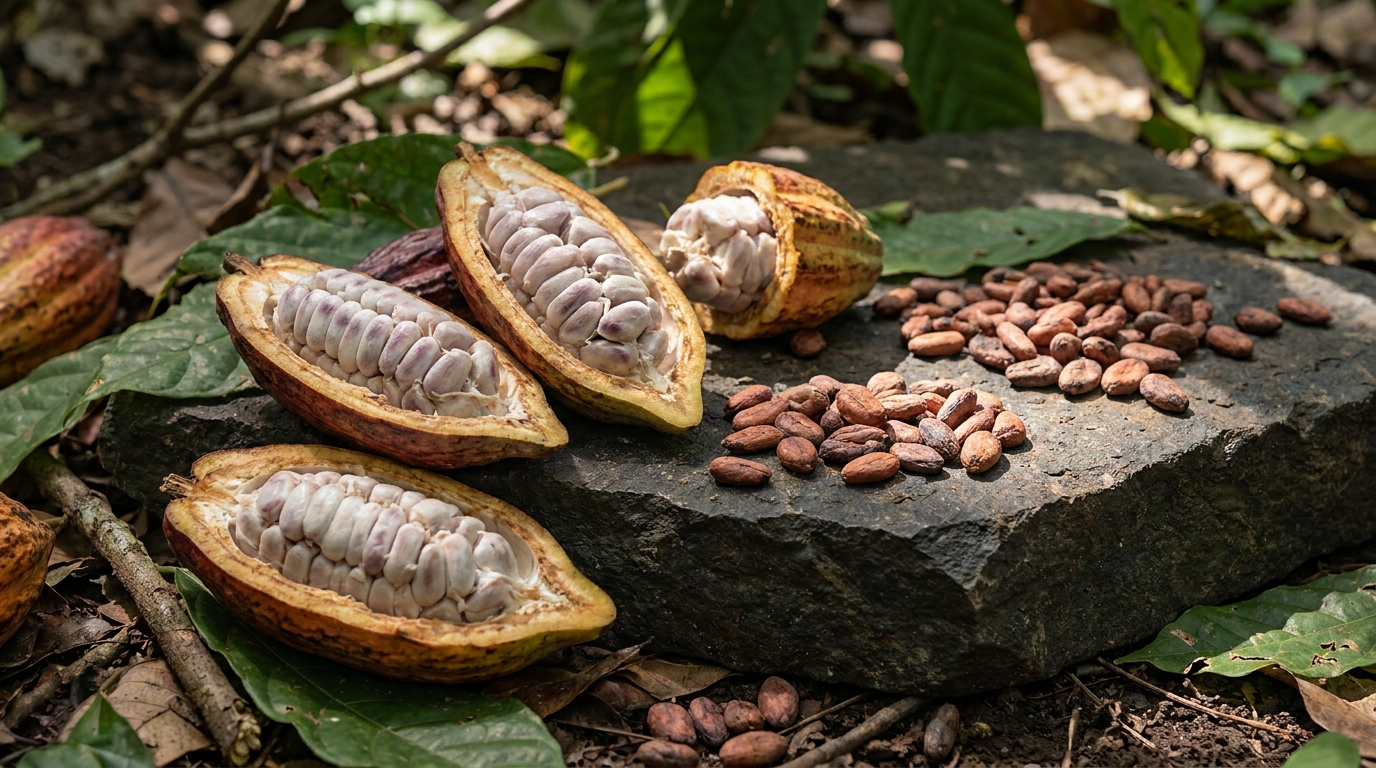
But alongside the industrial commodity, a different current has persisted. In parts Central and South America and Mexico, traditional cacao preparation has never disappeared. Indigenous communities have maintained the knowledge of how to process and drink cacao in ways that preserve its full character - minimally roasted, stone-ground, mixed with water rather than milk, without industrial sweetening.
That tradition is what ceremonial cacao draws from. The methods are old. The plant is the same plant that Maya priests prepared 2,000 years ago, and that Amazonian communities worked with 5,000 years before that.
The history didn't end with industrialization. It just went underground for a while. We are proud to be part of a small group who is bringing it back.