

The Biggest Cacao Study Ever Conducted
Science doesn't work the way most people think it does. You don't run one study and call it settled. You run many studies, from many angles, with many different populations. Then you look for the patterns that show up consistently.
For cacao and cardiovascular health, researchers had been building that body of evidence for years: small trials, meta-analyses, mechanistic studies. The data was promising. But the gold standard of medical research - the large, long-term, independently funded randomized controlled trial - hadn't been done yet.
Until 2022.
What Is COSMOS?
The COcoa Supplement and Multivitamin Outcomes Study - COSMOS for short - was designed to answer a specific question: does regular cocoa flavanol supplementation reduce the risk of cardiovascular events in the general population?
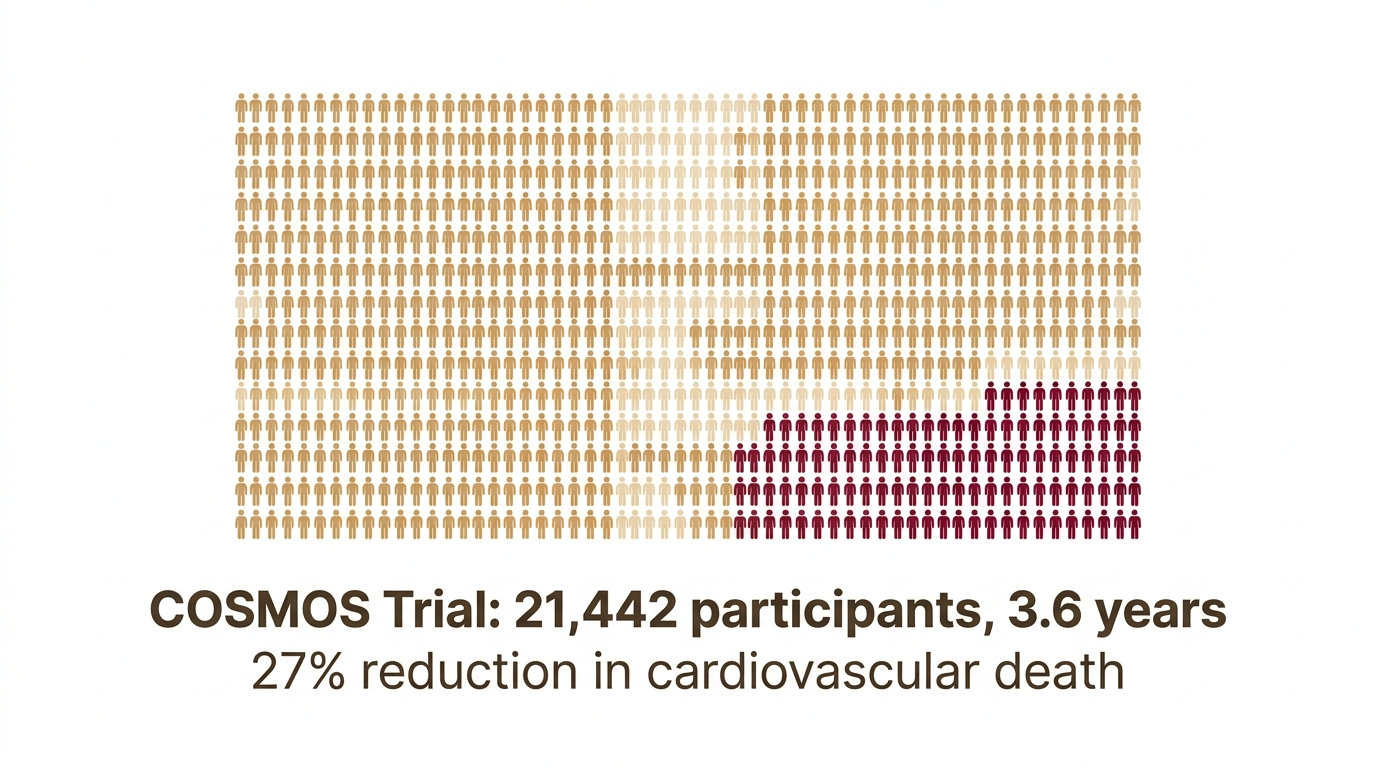
This wasn't a small pilot study. Researchers enrolled 21,442 adults across the United States. They were followed for a median of 3.6 years. Half the participants took a daily cocoa flavanol supplement; the other half took a matching placebo. Neither the participants nor the researchers evaluating outcomes knew who was taking what. The trial was double-blind, the design that medical science trusts most to eliminate bias.1
The scale of COSMOS places it among the largest nutrition trials ever conducted.
What They Found
The headline result: participants in the cocoa flavanol group experienced a 27% reduction in cardiovascular death compared to those in the placebo group - a finding that reached statistical significance (p = 0.04).1
In clinical research, a p-value below 0.05 is the conventional threshold for concluding that a finding is unlikely to be due to chance alone. This study crossed that threshold.
When researchers looked at total cardiovascular events (heart attacks, strokes, and related events combined), the cocoa flavanol group also showed a reduction, though that broader finding didn't reach statistical significance across the full intention-to-treat analysis. However, among participants who took their supplements consistently as prescribed - what researchers call a "per-protocol" analysis - the reduction in total cardiovascular events did reach significance.1
It's worth pausing on what a 27% reduction in cardiovascular death means in practical terms. Cardiovascular disease is the leading cause of death globally. Reducing the risk of dying from it by more than a quarter - through a naturally occuring dietary compound, not a pharmaceutical - is a meaningful finding.
Independent and Carefully Controlled
One of the most important features of COSMOS is its independence. The study was designed and conducted by researchers at major academic institutions including Brigham and Women's Hospital (affiliated with Harvard Medical School), and was primarily funded by the National Institutes of Health and other non-commercial sources.1
This matters because nutrition research has a well-documented problem with industry funding; studies funded by food companies tend to find more favorable results for those companies' products. COSMOS was designed specifically to provide the kind of independent, rigorous evidence that earlier observational studies and smaller trials could not.
Equally important: the researchers found no safety concerns associated with cocoa flavanol supplementation over the 3.6-year study period.
What It Means for Everyday Choices
COSMOS doesn't tell us that cacao is a cure for heart disease. What it tells us - alongside the dozens of smaller trials that preceded it - is that the compounds found in cacao have effects on the cardiovascular system that are real, measurable, and significant enough to detect in a 21,000-person study run over multiple years.
Heavily processed cacao loses most of its bioactive compounds. The research that generated findings like COSMOS was built on high-flavanol preparations - which means sourcing and processing matter as much as the ingredient itself.
The science took decades to get here. COSMOS is what it looks like when that accumulated evidence gets the large-scale trial it deserved.
Research Sources
- Sesso HD, Manson JE, Aragaki AK, et al. Effect of cocoa flavanol supplementation for the prevention of cardiovascular disease events: the COcoa Supplement and Multivitamin Outcomes Study (COSMOS) randomized clinical trial. American Journal of Clinical Nutrition. 2022;115(6):1490–1500. https://doi.org/10.1093/ajcn/nqab419