

The Molecule Behind the Magic
You've probably heard that cacao is "good for your heart." But that phrase gets thrown around a lot without anyone explaining why - what's actually happening inside your body when you drink it.
Here's the answer. It comes down to one molecule that your blood vessels can't function without, and a compound in cacao that helps your body make more of it.
Meet Your Endothelium
Running along the inside of every blood vessel in your body - arteries, veins, capillaries - is a single-cell-thick lining called the endothelium. It sounds obscure, but it's one of the most important tissues in your body. The endothelium is essentially the manager of your blood vessels: it controls how much they expand and contract, regulates blood flow, prevents clotting, and keeps inflammation in check.
When the endothelium is healthy, it produces a gas called nitric oxide (NO). Nitric oxide is the signal that tells blood vessel walls to relax and widen - a process called vasodilation. More nitric oxide means better blood flow, lower blood pressure, and a healthier cardiovascular system overall.
When the endothelium is damaged or dysfunctional - which happens over time with age, poor diet, smoking, sedentary behavior, and chronic stress - it produces less nitric oxide. Blood vessels become stiffer and narrower. Blood pressure rises. The risk of atherosclerosis (hardening of the arteries) increases. In fact, endothelial dysfunction is now understood to be one of the earliest warning signs of cardiovascular disease, often appearing years before any symptoms show up.1
This is where cacao comes in.
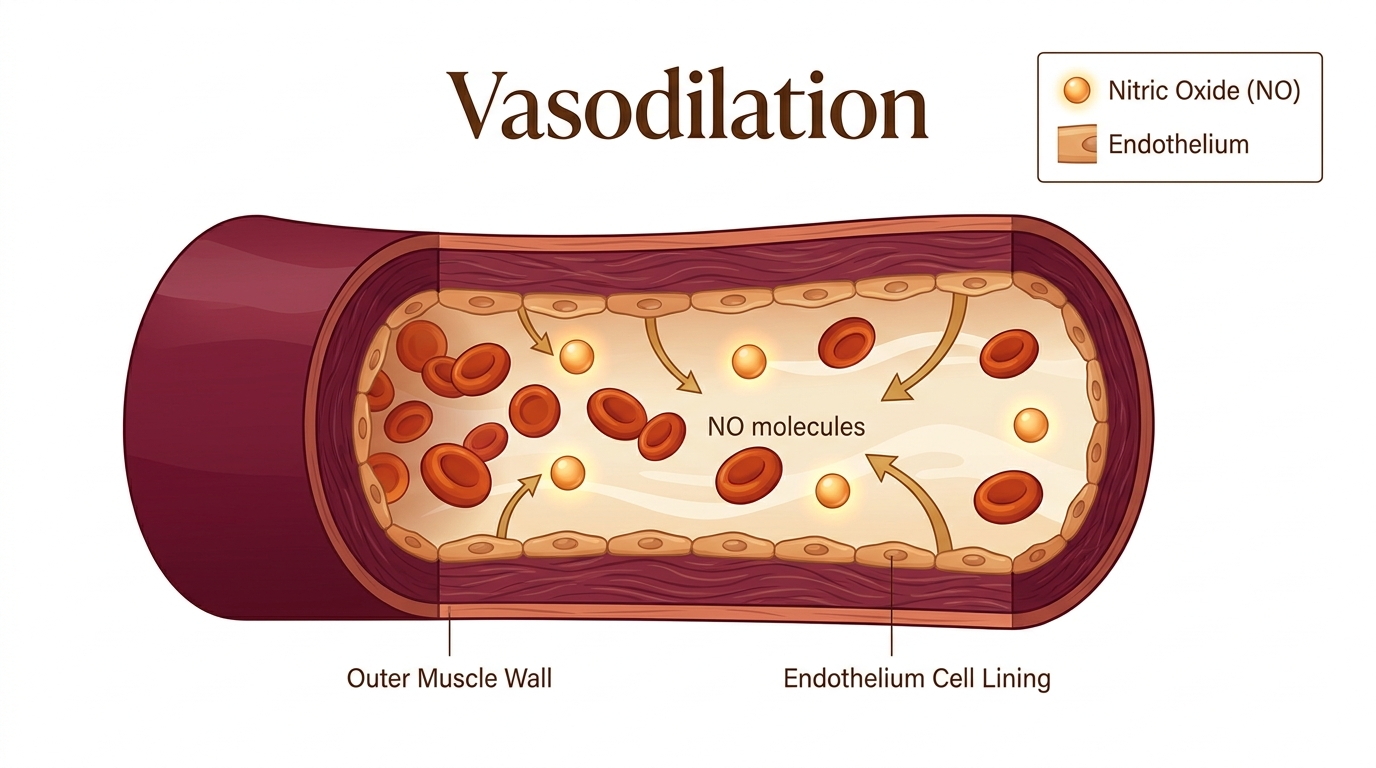
How Cacao Flavanols Boost Nitric Oxide
Cacao is rich in compounds called flavan-3-ols, more commonly known as flavanols. The most studied of these is a molecule called (–)-epicatechin. When you consume epicatechin - through high-quality cacao - it interacts directly with the cells of your endothelium and stimulates them to produce more nitric oxide.1
The effect is measurable. Researchers use a technique called flow-mediated dilation (FMD) to quantify how well blood vessels expand in response to blood flow - a direct proxy for endothelial health. A higher FMD reading means a healthier, more responsive endothelium.
A 2019 meta-analysis combining data from 15 separate clinical trials found that cocoa flavanol consumption produced a statistically significant increase in FMD of 1.17% on average.2 That number matters: independent cardiovascular research has shown that each 1% improvement in FMD is associated with approximately a 13% reduction in cardiovascular risk. These aren't trivial effects.
The same research identified an optimal dosage window: approximately 710 mg of total flavanols per day, with around 95 mg of epicatechin specifically. Below that, the effect was smaller. Above very high doses, the effect plateaued. Like most things in biology, the relationship isn't simply "more is better" - it's about hitting the right range.2
Who Benefits Most?
Early research found that the effects were most dramatic in people whose endothelial function was already compromised - smokers, people with coronary artery disease, and older adults. In one study, people with documented endothelial dysfunction showed marked improvement in blood vessel function after cocoa flavanol consumption.1
But subsequent research, including the Flaviola Health Study in healthy middle-aged adults, confirmed that flavanols improve endothelial function even in people who appear cardiovascularly healthy - suggesting that the benefits aren't reserved for those who are already unwell.
The Bigger Picture
The nitric oxide pathway is why so many different cardiovascular benefits show up in cacao research - reduced blood pressure, improved circulation, better arterial flexibility. They're not separate effects. They're all downstream consequences of the same thing: a healthier endothelium making more of the molecule it was designed to make.
High-quality cacao, minimally processed to preserve its flavanol content, is one of the most concentrated dietary sources of epicatechin that exists.
Research Sources
- Heiss C, et al. Vascular effects of cocoa rich in flavan-3-ols and the reversal of endothelial dysfunction. Journal of Cardiovascular Pharmacology. 2007;49(2):74–80. https://doi.org/10.1097/FJC.0b013e31802d0001
- Sun Y, Zimmermann D, de Castro CA, Actis-Goretta L. Dose-response relationship between cocoa flavanols and human endothelial function: a systematic review and meta-analysis of randomized trials. Food & Function. 2019;10(10):6322–6330. https://doi.org/10.1039/C9FO01747J