

Why Rituals Work
Every human culture that has ever been studied practices ritual. The forms vary enormously; there are rituals involving fire, water, fasting, feasting, silence, music, particular foods eaten at particular times, particular words spoken in particular sequences. The specific content differs across cultures and centuries. The practice itself is universal.
That universality is worth a deeper look. When something appears in every known human society, independent of contact with other societies, it's a sign that it's doing something genuinely useful.
What a Ritual Actually Is
The word gets misused. People say "my morning coffee is a ritual" when what they mean is "my morning coffee is a habit." The distinction is important.
A habit is something you do automatically, often without thinking. Rituals are different in a specific way: they involve attention and intention. A ritual is a practice you perform with some degree of deliberateness, often at regular intervals, that marks something - a transition, a beginning, a moment of connection.
Making tea the same way every morning, at the same time, with the same care - that can be a ritual. Sitting down to write with the same sequence of small preparations. A prayer before a meal. The way athletes prepare before competition. What makes it ritual rather than habit is the quality of attention brought to it, and the meaning the practitioner holds.
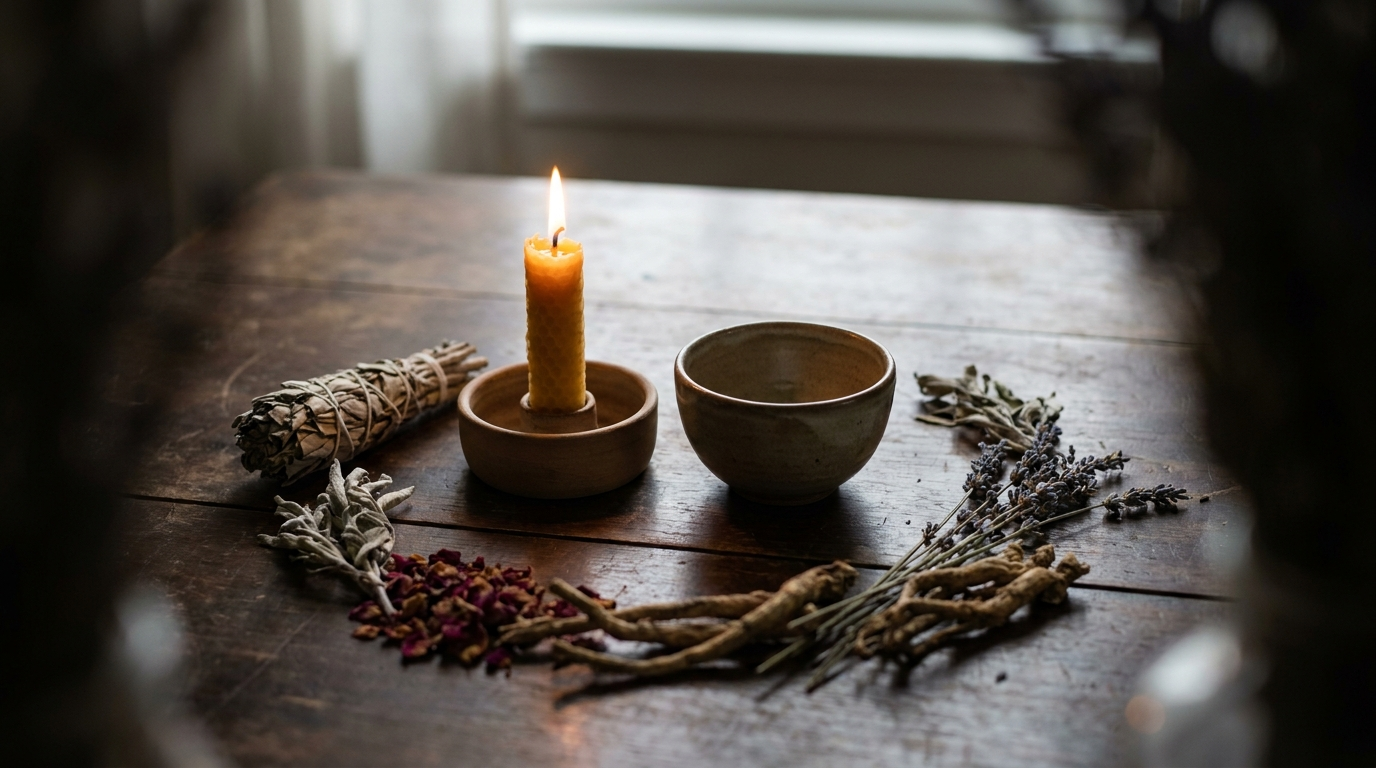
What Rituals Do for the Brain
Research in cognitive psychology and neuroscience has been catching up to what traditions have known for a long time: rituals work.
Studies have found that engaging in ritual behavior before a stressful task reduces anxiety and improves performance. One set of experiments published in Psychological Science found that people who performed a brief ritual before singing in public, taking a math test, or engaging in a competitive game showed lower cortisol levels and performed better than those who didn't. The effect held even when the rituals were entirely invented by the researchers and unfamiliar to participants - the structure and intention of the practice mattered more than any particular inherited form.
Other research has shown that rituals improve focus, increase feelings of self-control, and help people persist through difficult tasks. There's also evidence that shared rituals - rituals performed with other people - increase social bonding and feelings of group cohesion, which partly explains why communities have used them as a form of social glue since at least the emergence of organized human life.
One proposed mechanism is that rituals create a clear mental boundary - a "before" and "after" - that helps the brain transition between states. The deliberate, structured nature of ritual activates a different mode of processing than ordinary automatic behavior. Another is related to the sense of agency and control that performing a ritual creates: even when circumstances are uncertain or stressful, the ritual itself is within your control, and that provides comfort.
Transition and Marking Time
One of the most important functions of ritual is marking transitions. Humans are remarkably bad at natural transitions - the shift from work to rest, from one phase of life to another, from grief to whatever comes after it. We tend to carry one state into the next without awareness, struggling to fully arrive wherever we are.
Ritual creates a container for transition. Wedding ceremonies mark the beginning of a new kind of relationship. Funeral rites create space to acknowledge an ending. The ceremonies that surround graduation, birth, retirement - they exist because transitions need to be witnessed and marked to feel real.
This applies at the small scale too. The transition from sleep to full wakefulness is a minor daily threshold, but it sets the tone for everything that follows. A morning practice - whether meditation, movement, writing, or simply preparing and drinking something with care - creates that threshold deliberately rather than letting the day begin accidentally with the first notification on your phone.
Ritual as an Act of Presence
The philosopher Simone Weil wrote that "attention is the rarest and purest form of generosity." Rituals train attention. They require you to be somewhere in particular, doing something in particular, with some degree of consciousness about what you're doing.
In an environment designed to fragment attention - where every app is optimized to pull focus away from the present moment - the ability to sustain attention on a single thing, done slowly and deliberately, is a kind of resistance. And like any capacity, it's one that develops through practice.
This is part of why ritual traditions have persisted across vastly different cultures and historical periods. They solve a real problem: how to remain present in a life that constantly pulls you out of it.
Living Traditions
The most durable rituals tend to involve the body, not just the mind. Embodied practices - those that engage posture, movement, breath, taste, smell - create stronger anchors than purely cognitive exercises. This is why the oldest ritual traditions across cultures almost always involve sensory elements: incense, fire, music, food, drink.
Cacao has occupied that role in Mesoamerican cultures for thousands of years. The preparation itself - the slow grinding, the warming, the foam - was part of the ritual, not incidental to it. The drink was a vehicle for gathering, for intention-setting, for connection to something larger than the immediate moment. Those traditions persist today in indigenous communities in Central and South America and Mexico, and have informed the contemporary ceremonial cacao movement.
The specific form a ritual takes matters less than the quality of attention and intention brought to it. What endures across all traditions is the underlying impulse: to mark moments deliberately, to cultivate presence, and to acknowledge that some things in life deserve more than automatic, distracted consumption.
A morning practice centered on something prepared with care and consumed slowly is a small ritual. But small rituals, practiced consistently, accumulate into a different quality of life.